

An InBody scan is a quick body composition test: you stand on two footplates, hold two handles, and in under a minute it estimates how much of your weight is muscle, fat and water 1,2. It tells you more than a bathroom scale, but it's still an estimate. Here's what it measures, how accurate it is, and how to prepare so your results are worth comparing.
The Short Answer
- An InBody scan sends a small electrical current through your body and estimates muscle, fat and water in each arm, each leg and your trunk 3,2.
- It's very consistent from one scan to the next, which makes it good for tracking change 4.
- Next to a DEXA scan, InBody tends to read body fat about 3 to 4 percentage points lower on average, and more for some people 5,6,7.
- Prep matters: no food for 2 to 3 hours, no workout, sauna or cold plunge beforehand, and the same time of day each time 8,1.
- Skip it if you have a pacemaker or another implanted electronic device, or if you're pregnant 1.
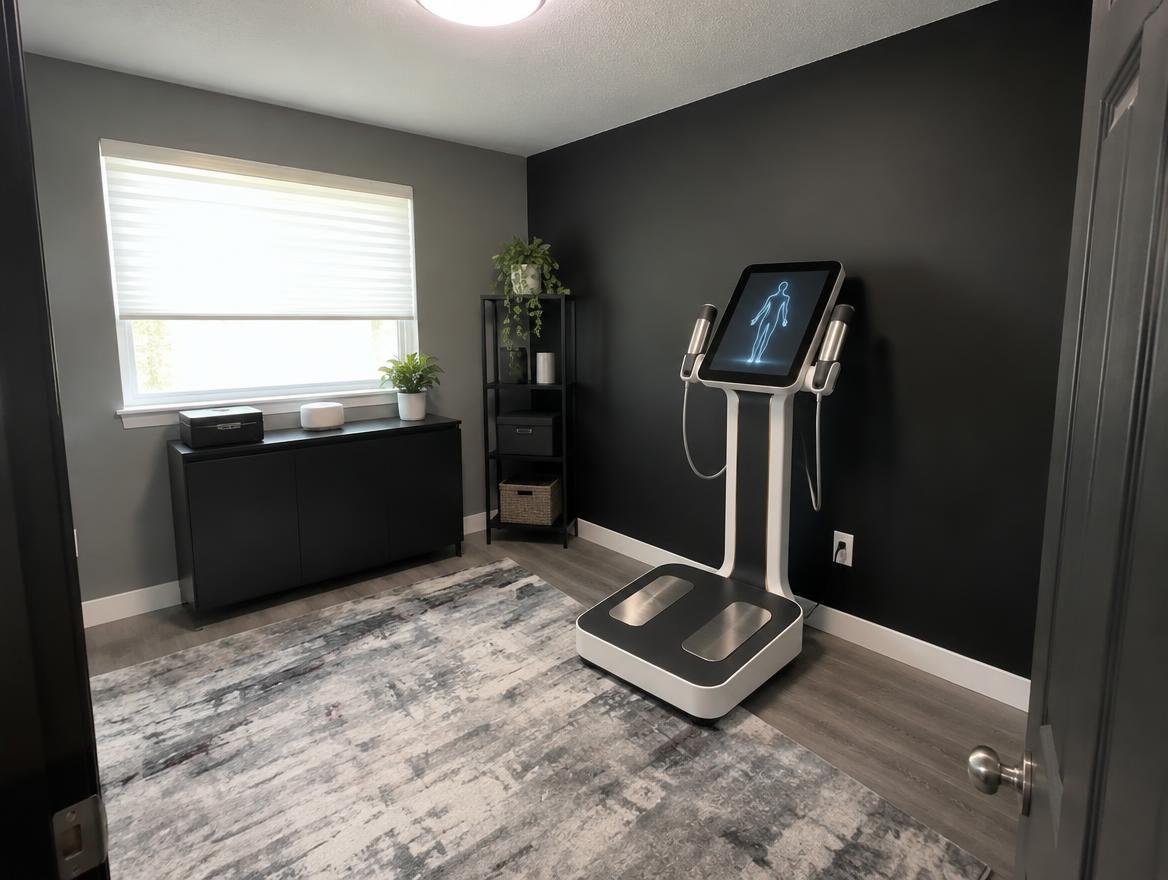
What Is an InBody Scan?
InBody is a brand of body composition analyzer. Its scanners use bioelectrical impedance analysis, or BIA: a small, harmless current passes through your body, and the device measures how much the current is slowed down. Water-rich lean tissue conducts electricity well, and fat doesn't, so the machine can estimate how much of each you carry 3,2.
InBody's clinic and gym models use several frequencies and measure your arms, legs and trunk separately, through eight contact points on the handles and footplates 3. Most people can't feel the current at all 2.
What the scan is like
You step onto the footplates barefoot, hold the handles with your thumbs on the electrodes, keep your arms slightly away from your sides, and stand still 9. The test itself takes about a minute 1. Nothing to undress beyond your shoes and socks, and no needles or radiation.
What an InBody Scan Measures
The printout depends on the model, but a typical InBody result sheet includes 10,11:
- Weight, skeletal muscle mass and body fat mass, shown side by side so you can see what your weight is made of.
- Percent body fat and BMI.
- Total body water, split into water inside and outside your cells, plus the ratio between them (InBody lists 0.36 to 0.39 as the typical range).
- Segmental analysis: lean mass in each arm, each leg and your trunk, which shows left-right differences.
- Visceral fat, the fat around your organs, as a level or an area depending on the model.
- Basal metabolic rate, an estimate of the calories your body uses at rest.
- History of your recent scans, so you can see the trend.
How to read your InBody results
Start with the trend, not one number. Compare scans taken under the same conditions, and look at muscle and fat together: if your weight stayed the same while muscle went up and fat went down, the scale would never have shown you that. The segmental section is useful if you're coming back from an injury or training one side harder than the other.
Keep the numbers in perspective. A physician at the University of Rochester Medical Center notes that research linking these scans to long-term health outcomes is still limited 2. They're a progress tool, not a diagnosis.
How Accurate Is an InBody Scan?
InBody scan accuracy has two parts: how consistent it is, and how close it is to a reference test.
Consistency: very good
In a study of 67 adults, repeat InBody scans agreed closely, with a measurement error of less than one percentage point of body fat 4. A tightly controlled 2024 study of the InBody 770 found the same 7. That's what makes it useful for tracking change over weeks and months.
Agreement with DEXA: close on average, wider for individuals
Studies comparing InBody with DEXA scans keep finding the same pattern: InBody reads body fat lower. The average gap was 3.1 points in 226 adults on the InBody 770 5, 3.2 points in 181 adults on the InBody 570 6, 3.3 points in female college athletes 12, and 4.0 points in a small group of fit adults 7.
Averages hide the spread. In the largest of those studies, individual results ranged from 2.6 points above DEXA to 8.9 points below, and the gap was biggest in people of normal weight 5. So if your InBody says 20% body fat, a DEXA scan might well say somewhere in the low to mid 20s.
Does it track change?
Mostly, yes. During a four-week diet, the InBody 770 picked up about the same drop in body fat as DEXA (1.4 vs 1.3 points) 13. In college football players over an off-season, it caught whole-body gains in lean mass but missed some of the arm and leg changes DEXA saw 14. Changes smaller than about 2 to 3 points of body fat can be measurement noise 4.
InBody vs DEXA
A DEXA (or DXA) scan uses two low-dose X-ray beams while you lie on a table for a few minutes. It measures fat, lean mass and bone, and it's the test most body composition studies use as their reference 15,16.
- InBody: about a minute, standing, no radiation, easy to repeat. Reads body fat a few points lower on average.
- DEXA: a few minutes lying down, a small X-ray dose, measures bone too, usually at a clinic or lab. Not done during pregnancy 16.
Neither is "the truth" for every person. The practical rule: pick one method and stick with it, so you're comparing like with like.
How to Prepare for an InBody Scan
Water, food and exercise all shift the reading, so preparation is the difference between a useful trend and random numbers. InBody's own guides differ a little on timing; this is the stricter version 8,1:
- Don't eat for 2 to 3 hours before the scan.
- Don't work out beforehand. Scan before training, not after.
- Do the scan before the sauna or cold plunge. InBody suggests waiting at least 20 minutes after heat or cold exposure.
- Skip alcohol for a day before. InBody's US guide also says no caffeine for 24 hours; if that's not realistic, keep your caffeine the same before every scan.
- Drink normally the day before, and use the restroom just before the scan.
- No lotion on your hands or feet, and take off socks and jewelry.
- Stand for 5 to 10 minutes before stepping on.
- Scan at the same time of day each time, ideally in the morning.
InBody also suggests not testing during your period, since water retention can inflate your lean mass 17, and scanning no more often than every 2 to 4 weeks, so there's time for real change to show 18.
Who should skip it
InBody's manuals say people with a pacemaker, implanted defibrillator or other implanted electronic medical device should not be tested, because the current could interfere with the device. Testing isn't recommended during pregnancy either, and metal implants can skew the results 1. If any of these apply, talk to your doctor first.
InBody Scan FAQ
What is an InBody scan?
A body composition test that uses a small, painless electrical current to estimate how much muscle, fat and water you carry, in each arm, each leg and your trunk 3,2.
How accurate is an InBody scan?
It's very consistent from scan to scan 4. Compared with DEXA, it tends to read body fat about 3 to 4 percentage points lower on average, and individual differences can be larger 5,7.
What does an InBody scan tell you?
Your weight broken into skeletal muscle mass, body fat mass and body water, plus percent body fat, lean mass for each arm, leg and your trunk, visceral fat and an estimated resting metabolic rate 10,11.
How do I prepare for an InBody scan?
Don't eat for 2 to 3 hours or work out beforehand, skip alcohol for a day, use the restroom, take off socks and jewelry, and scan at the same time of day each time. Do it before the sauna or cold plunge, not after 8,1.
Is an InBody scan safe?
For most people, yes: the current is small and most people can't feel it 2. People with a pacemaker or another implanted electronic device shouldn't be tested, and it isn't recommended during pregnancy 1.
Where can I get an InBody scan in Tampa?
At Evimero Wellness Club, 208 N Armenia Ave, Tampa, FL 33609. A scan is $40, and Diamond members get one complimentary scan per month. Book through Book a Session.
InBody at Evimero
InBody Body Composition Scan — $40
Detailed measurements of estimated skeletal muscle mass, body fat and other body composition metrics, whether you're setting a baseline or tracking change over time.
- Non-Member: $40
- Χρυσός (Gold): $40
- Διαμάντι (Diamond): One complimentary scan per month
Questions before you book? Call (813) 848-4672. 208 N Armenia Ave, Tampa, FL 33609.
This article is general information, not medical advice. Talk with your doctor before starting something new, especially if you are pregnant or have a heart condition or another health condition.
Sources
- InBody770 User's Manual. InBody. Test time, current, preparation and who should not be tested.
- Are InBody Scans More Accurate Than Weight Scales?. B. Ficarra. University of Rochester Medical Center, Health Matters, 2026.
- InBody Technology. InBody USA (manufacturer).
- Reliability and Agreement of Various InBody Body Composition Analyzers as Compared to Dual-Energy X-Ray Absorptiometry in Healthy Men and Women. McLester CN, Nickerson BS, Kliszczewicz BM, McLester JR. J Clin Densitom. 2020;23(3):443–450.
- Comparison of body composition assessment across body mass index categories by two multifrequency bioelectrical impedance analysis devices and dual-energy X-ray absorptiometry in clinical settings. Lahav Y, Goldstein N, Gepner Y. Eur J Clin Nutr. 2021;75:1275–1282.
- Proportional bias of multifrequency bioimpedance analysis is larger in Hispanic females than males. Nickerson BS, Snarr RL. Nutr Res. 2022;103:40–46.
- Reliability, biological variability, and accuracy of multi-frequency bioelectrical impedance analysis for measuring body composition components. Looney DP, Schafer EA, Chapman CL, et al. Front Nutr. 2024;11:1491931.
- InBody Preparatory Steps. InBody USA Help Center, 2022.
- The InBody Test. InBody USA (manufacturer).
- InBody 570 Results Interpretation. InBody (manufacturer).
- InBody 770 Results Interpretation. InBody (manufacturer).
- Comparison of total and segmental body composition using DXA and multifrequency bioimpedance in collegiate female athletes. Esco MR, Snarr RL, Leatherwood MD, et al. J Strength Cond Res. 2015;29(4):918–925.
- Comparison of Dual-Energy X-ray Absorptiometry (DXA) Versus a Multi-Frequency Bioelectrical Impedance (InBody 770) Device for Body Composition Assessment after a 4-Week Hypoenergetic Diet. Antonio J, Kenyon M, Ellerbroek A, et al. J Funct Morphol Kinesiol. 2019;4(2):23.
- Offseason Body Composition Changes Detected by Dual-Energy X-ray Absorptiometry versus Multifrequency Bioelectrical Impedance Analysis in Collegiate American Football Athletes. Boykin JR, Tinsley GM, Harrison CM, et al. Sports (Basel). 2021;9(8):112.
- DXA body composition analysis. UC Davis Health Sports Medicine.
- DXA Scan (Bone Density Test). Cleveland Clinic, 2024.
- Testing during menstruation. InBody USA Help Center, 2025.
- How often to test. InBody USA Help Center.


