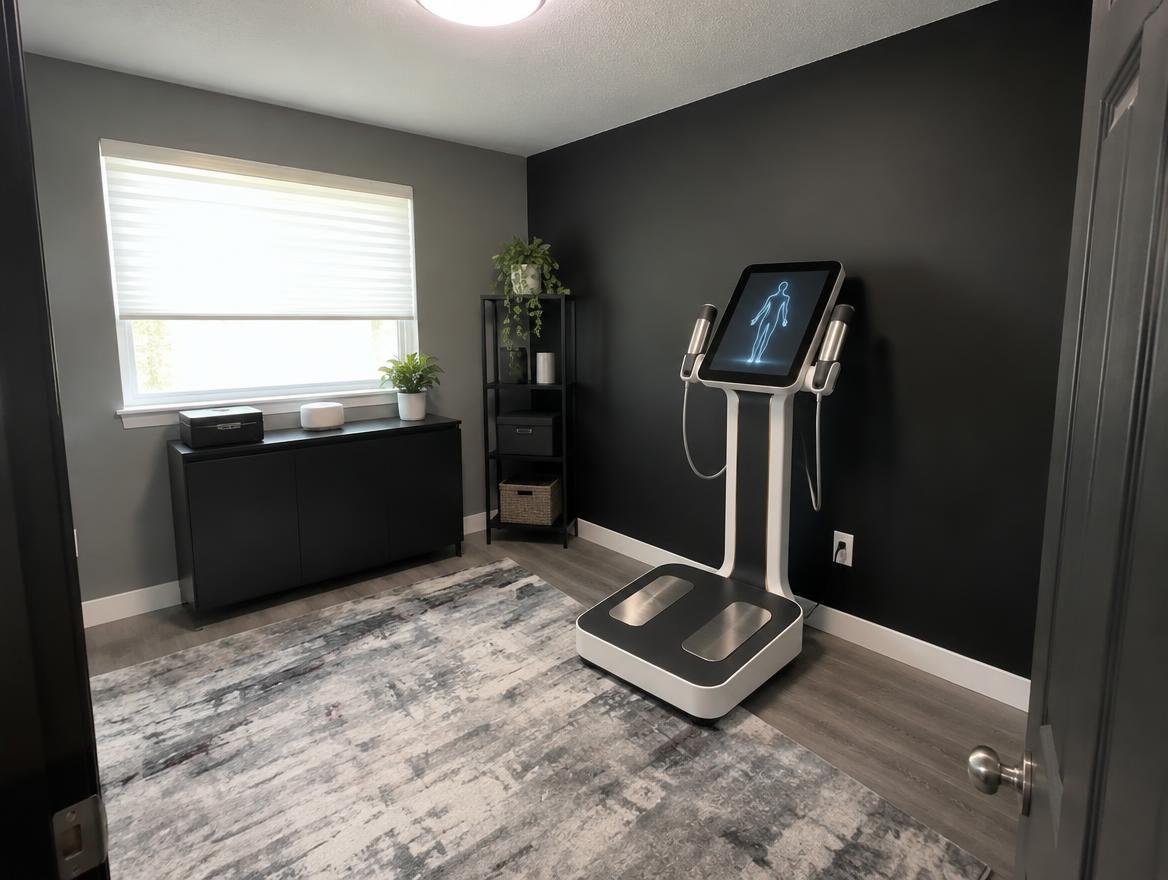

Shockwave therapy uses acoustic waves, delivered through the skin from a hand-held device, to treat certain muscle, tendon and joint problems 1,2. It's noninvasive and each session takes minutes. The evidence is good for some conditions and weak for others. Here's what it is, where the research supports it, what a session is like, and who shouldn't have it.
The Short Answer
- Shockwave therapy (ESWT) sends acoustic waves into tissue through the skin: no needles, no incisions, and little or no downtime 1.
- Best evidence: long-standing heel pain from plantar fasciitis, and calcium deposits in the shoulder tendons 3,4.
- Weak or mixed: tennis elbow, outer hip pain and Achilles problems 5,6,7.
- A typical course is 3 to 5 sessions, 1 to 2 weeks apart, and improvement can take 8 to 12 weeks 8,1.
- Side effects are usually short-lived: soreness, redness or bruising where you were treated 1,9.

What Is Shockwave Therapy?
Shockwave therapy, also called extracorporeal shockwave therapy or ESWT, uses a hand-held device to send acoustic waves through the skin into a sore tendon, ligament or other soft tissue 2. "Extracorporeal" just means the waves start outside the body.
You may have seen shockwave therapy advertised for other things, such as erectile dysfunction. This article is about muscles, tendons and joints, which is how Evimero uses it: for certain musculoskeletal conditions, when clinically appropriate.
How does shockwave therapy work?
The waves create mechanical stress in the tissue, and the cells respond: Mayo Clinic describes new blood vessel growth, cell activity and changes in how pain signals are sent. Mayo also notes that the exact mechanism is still not fully understood 1.
Focused vs radial shockwave
There are two main types of device 1,8:
- Focused shockwave concentrates its energy at a set depth, so it can reach deeper tissue, and even bone.
- Radial shockwave is strongest at the skin and fades as it goes deeper, which suits tendons and fascia near the surface. Strictly speaking it's a pressure wave, and Mayo Clinic calls it radial pressure wave therapy.
Studies use both, and which one fits depends on how deep the problem is.
What Shockwave Therapy Is Used For: The Evidence
Shockwave therapy benefits vary a lot by condition. Here's what the most recent reviews found.
Plantar fasciitis (heel pain): good evidence
Shockwave therapy for plantar fasciitis has the longest track record. The FDA first approved a shockwave device for chronic plantar fasciitis in 2000, for heel pain lasting six months or more after other treatments hadn't worked 10. A 2025 analysis of 22 randomized trials with 2,299 people found that shockwave beat placebo on treatment success, and medium and high intensities reduced pain more than placebo. Function didn't differ, and the certainty of the evidence was low 3.
Calcium deposits in the shoulder: good evidence
For calcific tendinopathy of the rotator cuff, a 2024 review of 21 trials found that shockwave beat sham treatment for pain and function at 24 weeks, and higher energy worked better than lower energy. The certainty of the evidence was very low 4.
Outer hip pain: short-term relief
For greater trochanteric pain syndrome, pain on the outside of the hip, a 2024 review of 8 trials found pain relief at 2 to 4 months. The improvement in function at 6 months wasn't large enough to matter, and most trials had a high risk of bias 6.
Tennis elbow and Achilles: weak evidence
A Cochrane review of 9 placebo-controlled trials with 1,006 people found little or no benefit for tennis elbow 5. For Achilles tendon problems, a 2026 review of 9 trials found no meaningful benefit over sham treatment, and its authors advise against routine use 7.
So, does shockwave therapy work?
For long-standing heel pain and calcium deposits in the shoulder, the evidence is reasonable. For other conditions it's weaker, and other treatments may be a better first step. A good provider will tell you which group your problem falls into.
What a Shockwave Therapy Session Is Like
- Before: your provider finds the sore area and checks that shockwave is appropriate for you.
- During: the hand-held applicator is pressed against your skin over the area and delivers rapid pulses. A session usually takes about 5 to 10 minutes 9,2.
- How it feels: it can be uncomfortable, but the intensity can be turned down 9. Sports medicine guidance suggests keeping discomfort at a moderate level for tendon problems 8.
- After: there's little or no activity restriction 1. A mild ache usually settles within hours 9.
How many sessions?
A typical course is 3 to 5 sessions, 1 to 2 weeks apart 8. Mayo Clinic describes 3 to 6 treatments spaced 3 to 7 days apart 2. Lasting improvement often takes 8 to 12 weeks 1, so judge it by how you feel over a couple of months, not the next day. An international expert panel also recommends avoiding anti-inflammatory painkillers such as ibuprofen during a course of treatment 8; ask your doctor before changing any medication.
Shockwave therapy side effects
The common ones are mild and temporary: pain at the treated spot, redness and bruising 1,8. They usually clear within a week 9. Tendon rupture has been reported, but rarely 8.
Who Shouldn't Have Shockwave Therapy
The contraindications for shockwave therapy depend on the device and where it's aimed. The International Society for Medical Shockwave Treatment says not to treat over 11:
- A cancerous tumor.
- A pregnancy.
- A pacemaker or implanted defibrillator.
- With high-energy focused devices, also the brain, spine, skull, ribs and lungs, or anyone with a significant bleeding disorder.
Some clinics are stricter and also exclude people under 18, people on blood thinners, people taking certain antibiotics, and anyone who has had a steroid injection in the area recently 9. Tell your provider about your medications and health history before your first session.
How Much Does Shockwave Therapy Cost?
Prices vary by clinic and device. At Evimero in Tampa, both Dr. Peri Morgan, DC, and Dr. Jason Goulding, DPT, offer shockwave therapy: $60 for a 10-minute standalone session, or $40 when you add it to a chiropractic visit or Recovery Session.
Shockwave Therapy FAQ
What is shockwave therapy?
A noninvasive treatment that sends acoustic waves through the skin, from a hand-held device, into sore tendons and other soft tissue. It's used for certain muscle, tendon and joint problems 1,2.
Does shockwave therapy work?
It depends on the condition. The evidence is reasonable for long-standing plantar fasciitis and calcium deposits in the shoulder, and weak for tennis elbow and Achilles problems 3,4,5,7.
Is shockwave therapy painful?
It can be uncomfortable during the session, but the intensity can be turned down. Any ache afterward usually settles within hours 9.
How many shockwave therapy sessions will I need?
A typical course is 3 to 5 sessions, 1 to 2 weeks apart. Improvement often takes 8 to 12 weeks to show 8,1.
What are the side effects of shockwave therapy?
Usually mild and temporary: pain at the treated spot, redness and bruising, which clear within about a week. Tendon rupture has been reported but is rare 1,8,9.
Who should not have shockwave therapy?
It shouldn't be aimed over a tumor, a pregnancy, or a pacemaker or defibrillator, and high-energy focused devices aren't used over the lungs, spine or skull. Some clinics also exclude people on blood thinners and under-18s 11,9.
How much does shockwave therapy cost in Tampa?
At Evimero Wellness Club, 208 N Armenia Ave, a standalone 10-minute session is $60, or $40 as an add-on to a chiropractic visit with Dr. Peri Morgan, DC or a Recovery Session with Dr. Jason Goulding, DPT. Book through Book a Session.
Shockwave Therapy at Evimero
Shockwave Therapy with Dr. Peri Morgan, DC or Dr. Jason Goulding, DPT
Both doctors offer shockwave therapy at Evimero, as a standalone session or added to a chiropractic visit or Recovery Session.
- Standalone Session, 10 Minutes: $60
- Add-On to a Chiropractic Visit or Recovery Session: $40
- Also available: localized cryotherapy and ultrasound therapy, 10 minutes each, at the same prices
Questions before you book? Call (813) 848-4672. 208 N Armenia Ave, Tampa, FL 33609.
This article is general information, not medical advice. Talk with your doctor before starting something new, especially if you are pregnant or have a heart condition or another health condition.
Sources
- Shockwave treatment: A new wave for musculoskeletal care. Romero JM. Mayo Clinic, Medical Professionals, 2025.
- Mayo Clinic Q and A: Shockwave therapy may help relieve foot problem. Bondi E. Mayo Clinic News Network, 2024.
- Comparative efficacy and acceptability of different intensity levels of extracorporeal shock wave therapy in adults with plantar heel pain: A systematic review and network meta-analysis. Zhao P, He Y, Li M, et al. PM R. 2025;17(12):1481–1493.
- The effectiveness of extracorporeal shock wave therapy for rotator cuff calcific tendinopathy. A systematic review with meta-analysis. Brindisino F, Marruganti S, Lorusso D, et al. Physiother Res Int. 2024;29(3):e2106.
- Shock wave therapy for lateral elbow pain. Buchbinder R, Green SE, Youd JM, et al. Cochrane Database Syst Rev. 2005;(4):CD003524.
- Extracorporeal Shockwave Therapy for Greater Trochanteric Pain Syndrome: A Systematic Review with Meta-Analysis of Randomized Clinical Trials. Rhim HC, Shin J, Beling A, et al. JBJS Rev. 2024;12(8).
- Shockwave Therapy for Midportion and Insertional Achilles Tendinopathy: A Nail in the Coffin? A Systematic Review With Meta-Analysis. Korakakis V, Kotsifaki R, Sotiralis Y, et al. J Orthop Sports Phys Ther. 2026;56(5):282–299.
- Recommendations for use of extracorporeal shockwave therapy in sports medicine: an international modified Delphi study. Rhim HC, Singh M, Maffulli N, et al. Br J Sports Med. 2025;59(18):1287–1301.
- Extracorporeal shockwave therapy (ESWT). Patient leaflet. Kent Community Health NHS Foundation Trust, 2025.
- Premarket Approval P990086: OssaTron. U.S. Food and Drug Administration, 2000.
- Consensus Statement on ESWT Indications and Contraindications. International Society for Medical Shockwave Treatment (ISMST), 2016.